

What Is 316L Stainless Steel Jewellery? A South African Guide
What 316L means, why it is the metal under waterproof jewellery, how it compares with brass, silver and gold, and how to tell the real thing.

316L stainless steel is the metal under every NUUR piece, and it is the reason you can shower, swim, train and sleep in our jewellery without it rusting, turning green or losing its shape. It is a low carbon, molybdenum bearing grade of stainless steel, the same family of steel used for surgical instruments, kitchen equipment and boat fittings that sit in sea water every day. When it carries a layer of 18K gold plating, you get the colour of gold on a base that water simply does not bother.
This guide explains what 316L actually is, what the numbers and the letter mean, why it behaves so differently from the brass and copper inside most fashion jewellery, and how to tell whether the piece you are about to buy is made from it. If you just want to shop, the whole range lives in our waterproof jewellery collection, and every piece in it is 18K gold plated 316L stainless steel.
What is 316L stainless steel?
Stainless steel is not one metal. It is a family of iron alloys that all contain at least about 10.5 percent chromium, which is what makes them "stainless". Within that family there are dozens of grades, each with a slightly different recipe, and each recipe changes how the steel behaves around water, salt, heat and skin.
316L belongs to the austenitic group of stainless steels, the group known for resisting corrosion rather than for being extremely hard. A typical 316L recipe looks like this:
- Chromium, roughly 16 to 18 percent. Chromium is the ingredient that protects the surface. It reacts with oxygen in the air to form an extremely thin, invisible film of chromium oxide over the whole piece.
- Molybdenum, roughly 2 to 3 percent. This is what separates 316 from the more common 304 grade. Molybdenum makes the protective film far better at resisting chlorides, which is the chemistry found in sea water, swimming pools and sweat.
- Carbon, no more than 0.03 percent. The "L" stands for low carbon. Less carbon means the steel keeps its corrosion resistance even after it has been heated, cast, soldered or polished during manufacturing.
- Iron makes up most of the rest, together with small amounts of other alloying elements that keep the structure stable.
You will sometimes see 316L described as surgical steel or marine grade steel. Those are informal names rather than official standards, but they point at the same thing: 316L is chosen when a metal has to stay clean and intact in wet, salty or demanding conditions for years.
What do "316" and "L" actually mean?
The number comes from a grading system that has been used for stainless steel for decades. The 300 series are the austenitic stainless steels. Within that series, 304 is the everyday workhorse used for sinks and cutlery, and 316 is the upgraded version with molybdenum added for harsher environments.
The "L" is a separate detail. Ordinary 316 can contain a little more carbon. When steel with more carbon is heated, some of that carbon can bond with chromium at the grain boundaries inside the metal, which leaves small zones with less chromium available to protect the surface. Metallurgists call this sensitisation. Keeping carbon very low, as 316L does, avoids the problem, so the finished piece is protected evenly from the clasp to the pendant.
For jewellery, this matters more than it sounds. A bracelet is not a flat sheet of steel. It has links, joins, soldered jump rings, set stones and a clasp, and every one of those points has been heated or worked during production. Low carbon steel keeps its protection at exactly those weak points, which is where cheaper jewellery usually starts to fail first.
Why 316L is the right base for waterproof jewellery
The word waterproof gets used loosely in jewellery. What it should mean is simple: water, sweat and the products you use every day do not damage the piece. Whether a piece can honestly be called waterproof depends almost entirely on the metal underneath the colour.
The chromium oxide layer repairs itself
The protective film on stainless steel is not a coating that someone applied. It forms by itself from the chromium in the alloy whenever the surface meets oxygen. If the surface is scratched, the exposed steel forms a new film within moments. This is why a 316L chain can be worn in the shower for months and still look and feel the same: there is no point at which water reaches unprotected iron.
Molybdenum stands up to salt and chlorine
South African summers mean salt water in Durban, Umhlanga and Cape Town, chlorinated pools at home and at the gym, and a lot of sweat. Chlorides are the main enemy of ordinary metals, because they attack protective films and start small pits in the surface. Molybdenum is the reason 316L resists that attack far better than 304 stainless steel, silver or brass. It is why 316L is used for boat fittings and coastal railings.
There is no copper to turn your skin green
The green ring that some jewellery leaves on fingers and wrists comes from copper. When copper or brass meets sweat and moisture, it forms copper salts, and those salts transfer onto skin. Most low cost fashion jewellery is made from brass or copper alloys with a thin coloured layer on top, so once that layer thins, the copper underneath meets your skin. A 316L base contains no copper, so there is nothing to make the green mark. Our guide on jewellery that does not turn skin green goes deeper into the chemistry.
It keeps its shape
Steel is much harder than gold or silver. A 316L ring does not bend out of round when you carry shopping bags, and a 316L chain does not stretch the way soft silver chains can. That hardness also means the surface resists the fine scratches that dull softer metals.
316L compared with other jewellery metals
Every jewellery metal is a trade off between price, colour, weight and how it handles daily life. This is how 316L compares with the materials you are most likely to see when shopping in South Africa.
| Metal | Water, salt and sweat | What to expect |
|---|---|---|
| 316L stainless steel | Resists rust and pitting in sea water, pools and sweat | Hard, keeps its shape, no copper, takes 18K gold plating well |
| 304 stainless steel | Good with fresh water, weaker with salt and chlorine | Cheaper grade, no molybdenum |
| Brass or copper alloy | Reacts with sweat and water | Can turn skin green once the surface wears |
| Sterling silver (925) | Tarnishes with moisture and sulphur in the air | Soft, darkens and needs polishing |
| Solid gold, 9K to 18K | Does not rust or tarnish in normal wear | Soft, heavy and priced far higher |
| Titanium | Excellent in water | Very light, harder to plate, fewer styles |
The short version: solid gold and titanium are excellent in water but come with clear limits on price or design. Silver and brass are pretty but need care. 316L gives you the water behaviour of the premium metals with the design freedom and plating quality of fashion jewellery, which is why it has become the standard base for waterproof jewellery worldwide.
What 18K gold plating adds to 316L
Raw 316L has a cool, silvery grey colour. To give it the warm colour of gold, the surface is finished with real 18K gold plating. The steel does the structural work and the 18K gold plating provides the colour.
The quality of plating depends heavily on the base. Gold plating on brass sits on a metal that is constantly reacting with its surroundings, so any thin spot lets the brass discolour and the colour starts to fade from below. On 316L, the base underneath is already stable, so the plating is not being undermined from the inside. That is why 18K gold plated stainless steel keeps its colour so much longer than gold plated brass, and why we can tell you to wear it in the sea and the shower.
We use the same approach for the other finishes in the range. The Luna Earrings, for example, come in an 18K gold plated finish and a silver finish, both on the same 316L base. If you want to understand plating in more depth, read does gold plated jewellery tarnish.
Is 316L stainless steel good for sensitive skin?
For most people with sensitive skin, 316L is one of the most comfortable metals to wear. The same stable chromium oxide film that protects the steel from water also limits how much of the metal interacts with your skin. That is why 316L is a standard choice for medical instruments and why so many people who react to cheap fashion jewellery can wear stainless steel all day.
Earrings are where sensitivity shows up first, because the post sits inside a pierced lobe. The metal in all of our earrings, posts included, is 316L stainless steel, and you will find them gathered with the rest of our gentle pieces in jewellery for sensitive skin. For a full walk through, see the best jewellery for sensitive skin.
A sensible note: no metal suits every single person. If you have a diagnosed metal allergy, speak to your doctor or dermatologist about which metals are right for you.
How to tell if jewellery is really 316L
Because 316L has a strong reputation, the number gets printed on listings that do not deserve it. A few checks help you separate the real thing from marketing.
- Look for the full grade, not just "stainless". Plenty of sellers say "stainless steel" when the piece is 201 or 304 grade. A brand that uses 316L will usually say so plainly in the product details.
- Check what the seller promises about water. If the listing tells you to remove the piece before washing your hands, that tells you something about the base metal. A 316L piece does not need that warning.
- Feel the weight. Steel has real heft. A large pendant that feels almost weightless is more likely to be hollow, plated aluminium or zinc alloy.
- Try a magnet, with care. Austenitic stainless steels like 316L are largely non magnetic. A strong pull suggests a different grade or a different metal entirely, although a very light attraction can appear at clasps and springs that have been heavily worked.
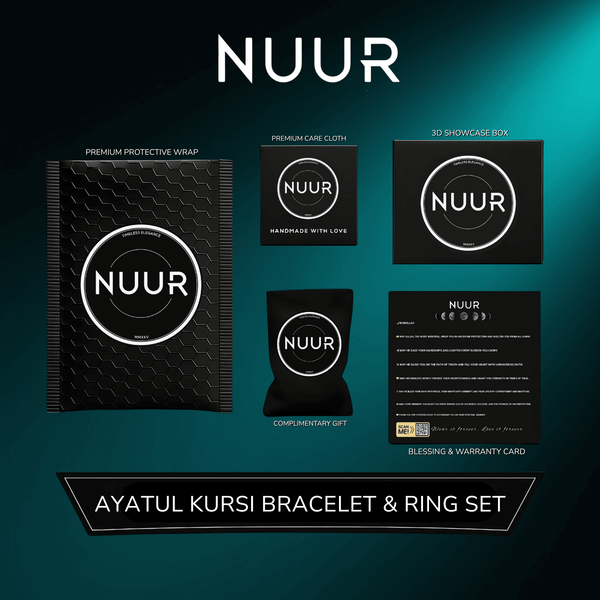
- Ask about the warranty. A brand confident in its base metal will put a written warranty on colour and manufacturing. Ours is six months on colour fading and manufacturing defects, printed on the Blessing & Warranty Card or Prayer & Warranty Card inside every box.
NUUR pieces made from 316L stainless steel
Every piece we sell is 316L stainless steel. A few examples from each type, with the measurements from their size cards, so you know exactly what you are buying.
Bracelets
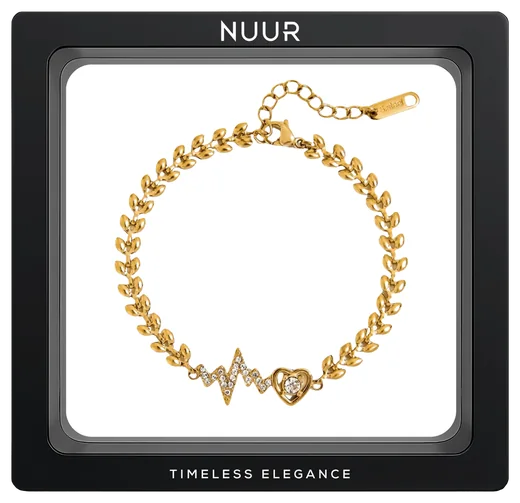
The Mina Bracelet is a woven mesh band, 0.81 cm high and 17.5 cm closed with a 5 cm extender, that lies flat and moves like fabric. The Elva Bracelet sets white zircon into the front links of a curb chain, 19 cm end to end. For something with stones all the way round, the Aurelia Tennis Bracelet is 17.5 cm end to end. See the full range in waterproof bracelets and waterproof tennis bracelets.
Necklaces
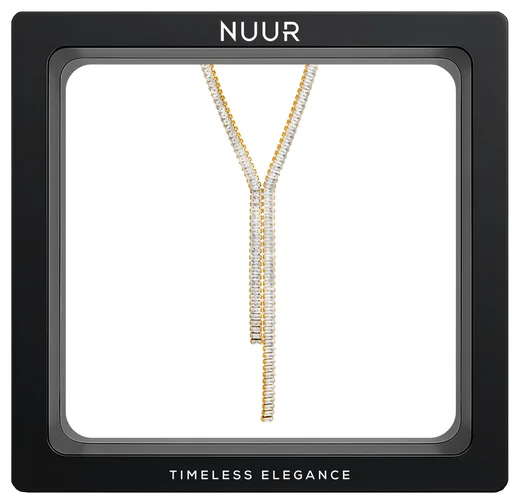
The Kaia Necklace gives you three layers at 39, 41 and 43 cm on one clasp, with a 5 cm extender, so the chains never tangle. The Elva Necklace is a heavy curb chain with zircon across the front, 40 cm with a 5 cm extender. Browse them all in waterproof necklaces.
Earrings
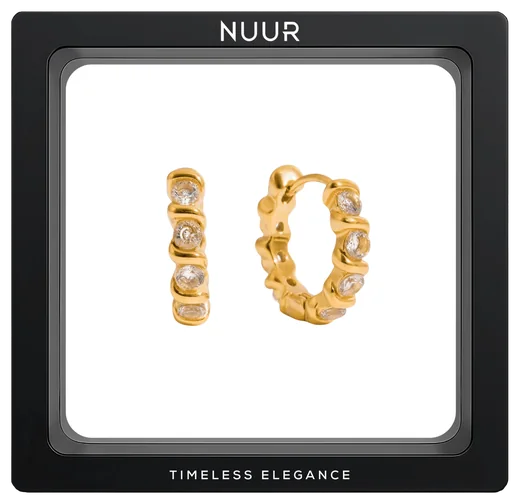
The Luna Earrings are huggie hoops 1.10 cm across, and the pair weighs just 1.8 g, light enough to sleep in. The Astra Earrings set small zircon stars into a thick rounded band. More in hypoallergenic waterproof earrings.
Rings
The Seraphina Ring carries a 2.69 cm wing across the finger on a 0.49 cm band. The Mina Ring is a woven mesh band in size 7 and size 8, made to pair with the Mina Bracelet. More in waterproof rings.
Caring for 316L stainless steel jewellery
The good news is that 316L asks for very little. You can wear it in the shower, the sea, the pool and at the gym. A few habits keep the 18K gold plating looking its best for longer:
- Rinse and dry after the sea or the pool. Salt and chlorine will not harm the steel, but a quick rinse in fresh water and a pat dry keeps residue off the surface.
- Use mild soap, never abrasives. Warm water, a drop of gentle soap and a soft cloth are all it needs. Avoid toothpaste, scouring powders and silver dips, which can scratch or strip plating.
- Store pieces separately. Steel is hard, so a ring stored loose against a plated chain can scratch it. Use the gift box or a soft pouch.
- Use the care cloth. Every NUUR order comes with a care cloth for a quick polish.
Our jewellery care guide and how to clean gold plated jewellery at home cover the details step by step.
Is 316L jewellery worth it?
If you want jewellery that you put on and forget about, yes. The value of 316L is not just that it lasts. It is that it removes the small daily decisions: taking a ring off before washing dishes, leaving a bracelet on the bedside table before the gym, deciding not to wear a necklace to the beach. With a 316L base and 18K gold plating, the piece simply stays on.
It is also a fair middle ground on value. Solid gold pieces with the same look would cost many times more and would be softer in daily wear. Brass pieces cost less up front but often need replacing once the colour fails. You can see how this plays out across a South African year in is waterproof jewellery worth it in South Africa.
Questions about 316L stainless steel jewellery
Does 316L stainless steel rust?
No, not in normal wear. The chromium in 316L forms a protective film that renews itself, and the molybdenum helps it resist salt water, chlorine and sweat. That is why 316L is used for boat fittings and medical instruments.
Can I shower and swim with 316L jewellery?
Yes. You can shower, swim in the sea or a pool, train and sleep in 18K gold plated 316L stainless steel jewellery. A quick rinse in fresh water after the sea or the pool keeps it looking its best.
Will 316L stainless steel turn my skin green?
No. The green mark comes from copper reacting with sweat. 316L contains no copper, so it cannot leave that mark.
What is the difference between 304 and 316L stainless steel?
316L contains molybdenum and less carbon. The molybdenum gives it much better resistance to salt and chlorine, and the low carbon keeps its corrosion resistance even at joins and clasps that were heated during manufacturing.
Is 316L stainless steel the same as surgical steel?
Surgical steel is an informal name rather than an official grade, but it most often refers to 316L. The name comes from its use in medical instruments.
Can a 316L ring be resized?
Not easily. Steel is much harder than gold or silver, so most jewellers cannot resize it. Choose the right size from the start with our guide to measuring your ring size at home.
Is all NUUR jewellery made from 316L stainless steel?
Yes. Every NUUR piece is 316L stainless steel, finished in 18K gold plating, 18K rose gold plating, silver or black depending on the design, or left as polished steel on the Zulfiqar Necklace. Every order ships free across South Africa, is dispatched within 24 hours on business days and arrives gift boxed.